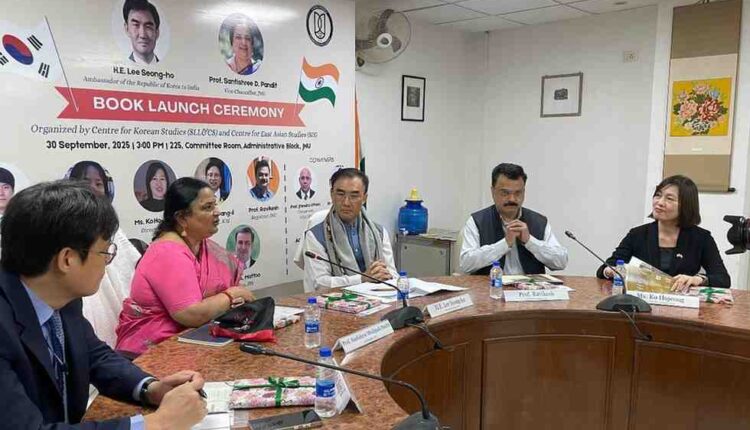
Jawaharlal Nehru University (JNU) recently hosted a landmark academic and cultural event featuring His Excellency Lee Seong-Ho, Ambassador of the Republic of Korea to India. Jointly organised by the Centre for Korean Studies (CKS), School of Language, Literature and Culture Studies (SLL&CS), and the Centre for East Asian Studies (CEAS), School of International Studies (SIS), the event celebrated the successful completion of a five-year project supported by the Academy of Korean Studies (AKS).
Prof. Ravikesh, Registrar of JNU and Project Director, led the initiative to completion despite a one-year extension due to the COVID-19 pandemic. The project achieved remarkable success, culminating in the publication of 23 scholarly books — eight of which were officially launched at the ceremony. The project’s impact spanned across South Asia, with contributions from Korean language and culture scholars in India, Nepal, Bangladesh, and Sri Lanka.
The event was graced by Prof. Santishree D. Pandit, Vice Chancellor of JNU, and Ambassador Lee Seong-Ho, who also met with the Vice Chancellor prior to the ceremony. Distinguished guests included Park Sung-il, Minister Counsellor; Ms Jung Hye Won, First Secretary; and Ms Ko Ho-jeong, Director, Korea Education Centre (KEC), all from the Embassy of the Republic of Korea. The event was convened by Prof. Jitendra Uttam, Chairperson, CEAS, SIS, and Dr. Kaushal Kumar, Chairperson, CKS, SLL&CS.
Prof. Ravikesh introduced the AKS project, highlighting its outcomes and its pivotal role in strengthening Korean Studies and fostering academic collaboration across South Asia. The highlight of the day was the release of eight scholarly volumes that collectively represent a milestone in regional Korean Studies research.
Key publications launched included:
-
Nativized Textbook on Korean Literature, by Prof. Kim Do Young, Prof. Ravikesh, and Dr. Satyanshu Srivastava – a foundational text introducing modern Korean fiction and poetry through comparative perspectives with Indian literature.
-
Nativized Textbook on Korean Culture, by Prof. Kim Young Soon, Dr. Neerja Samajdar, and Dr. Kaushal Kumar – an engaging guide designed for Indian learners, exploring Korean culture through festivals, language, K-pop, food, and multiculturalism.
-
Korean Studies in India and South Asia, edited by Prof. Ravikesh – an interdisciplinary exploration of gender, religion, media, and soft power within the regional Korean Studies framework.
-
Emerging Trends in Korean Studies in South Asia: An Inter-Cultural Perspective, Vol. II, edited by Dr. Satyanshu Srivastava and Sanjay Kumar Jha – a compilation of essays on literature, foreign policy, women’s participation, and language education.
-
Korean Studies in India & South Asia: Literature & Education, edited by Prof. Ravikesh – exploring intersections of Korean literature, folklore, diaspora, and translation in South Asian contexts.
-
Emerging Trends in Korean Studies in India: An Interdisciplinary Perspective, Vol. II, edited by Dr. Neerja Samajdar and Dr. Kaushal Kumar – analysing Korea’s socio-cultural and economic links with India through studies on cinema, gender, and Hallyu.
-
Korean Studies in India & South Asia: An Inter-Cultural Perspective, edited by Dr. Kaushal Kumar – focusing on soft power, diplomacy, youth culture, and trade relations shaping Korea–South Asia cooperation.
-
Dwaar ke Bahar Murgi (The Hen Who Dreamed She Could Fly) by Hwang Seon-Mi – a celebrated Korean classic, now translated into Hindi by Prof. Ravikesh and Naushad Aalam, adding to the growing accessibility of Korean literature in India.
Collectively, these volumes reflect the growing depth and diversity of Korean Studies in South Asia and mark a significant step in the indigenisation of the field.
The second segment of the event featured an engaging Open House session with Ambassador Lee Seong-Ho, where faculty and students from CKS and CEAS presented their ongoing work and future research plans. The Ambassador assured continued academic and institutional support from the Korean Embassy, emphasising the importance of bilateral collaboration in education and research.
Students actively interacted with the Ambassador, posing insightful questions about cultural exchange, foreign policy, and academic opportunities in Korea. His Excellency expressed optimism about future high-level exchanges between India and Korea.
The event concluded with closing remarks from Prof. Jitendra Uttam and a vote of thanks by Dr. Kaushal Kumar, who warmly acknowledged the Ambassador and dignitaries for their presence and support. He reiterated JNU’s commitment to advancing Korean Studies and expressed hope for many more such enriching academic collaborations in the years to come.