South Korea has exceeded its goal of attracting 300,000 international students, reaching 305,329 as of August 2025, according to ICEF Monitor and data from the Korea Immigration Service. Of these, 225,769 are enrolled in university degree programs on D-2 visas, while 79,500 are studying Korean on D-4-1 visas. A small number, 60 students, hold D-4-7 visas for foreign language training.
The international student population has grown 16% year-on-year and 47% since mid-2023, when the country had just over 207,000 foreign students. The government had set its 300,000-student target for 2027, making this achievement nearly two years ahead of schedule.
Most foreign students come from China and Vietnam, which together account for 64% of the total enrolment. Vietnam leads with 107,807 students, followed by China with 86,179. Other countries with significant numbers include Uzbekistan, Mongolia, and Nepal.
The growth reflects South Korea’s active policies under the “Study Korea 300K Project.” In 2023, the government increased part-time work allowances for international students. Students in language or bachelor’s programs can now work 25 hours per week, while master’s and doctoral students may work 35 hours on weekdays. All students are permitted unlimited hours on weekends and holidays.
Financial requirements for D-2 visas were also lowered, from about US$20,000 to 20 million won (roughly US$15,400). Degree-seeking students applying outside the Seoul metropolitan area face an even lower threshold of 16 million won.
Post-study work opportunities are also being expanded. From 2025, international graduates can remain in the country for up to three years to seek employment, compared with the current allowance of six months with a possible extension to two years. The government plans to broaden the types of jobs students can apply for and increase the time job holders can remain in South Korea.
Scholarship opportunities have grown as well. The Global Korea Scholarship (GKS) program now offers 2,700 scholarships for STEM students and 6,000 for non-STEM students. STEM graduates are being fast-tracked for permanent residency, while the residency requirement for graduate and postgraduate students applying for permanent residency has been reduced from six to three years. Korean universities have also broadened the range of accepted Korean-language tests and are considering lowering the TOPIK proficiency level required for international students, although some academics have raised concerns about its impact on student success.
South Korea’s rising international student numbers underline its growing appeal as a study destination in Asia, alongside China, Japan, Taiwan, and Malaysia.
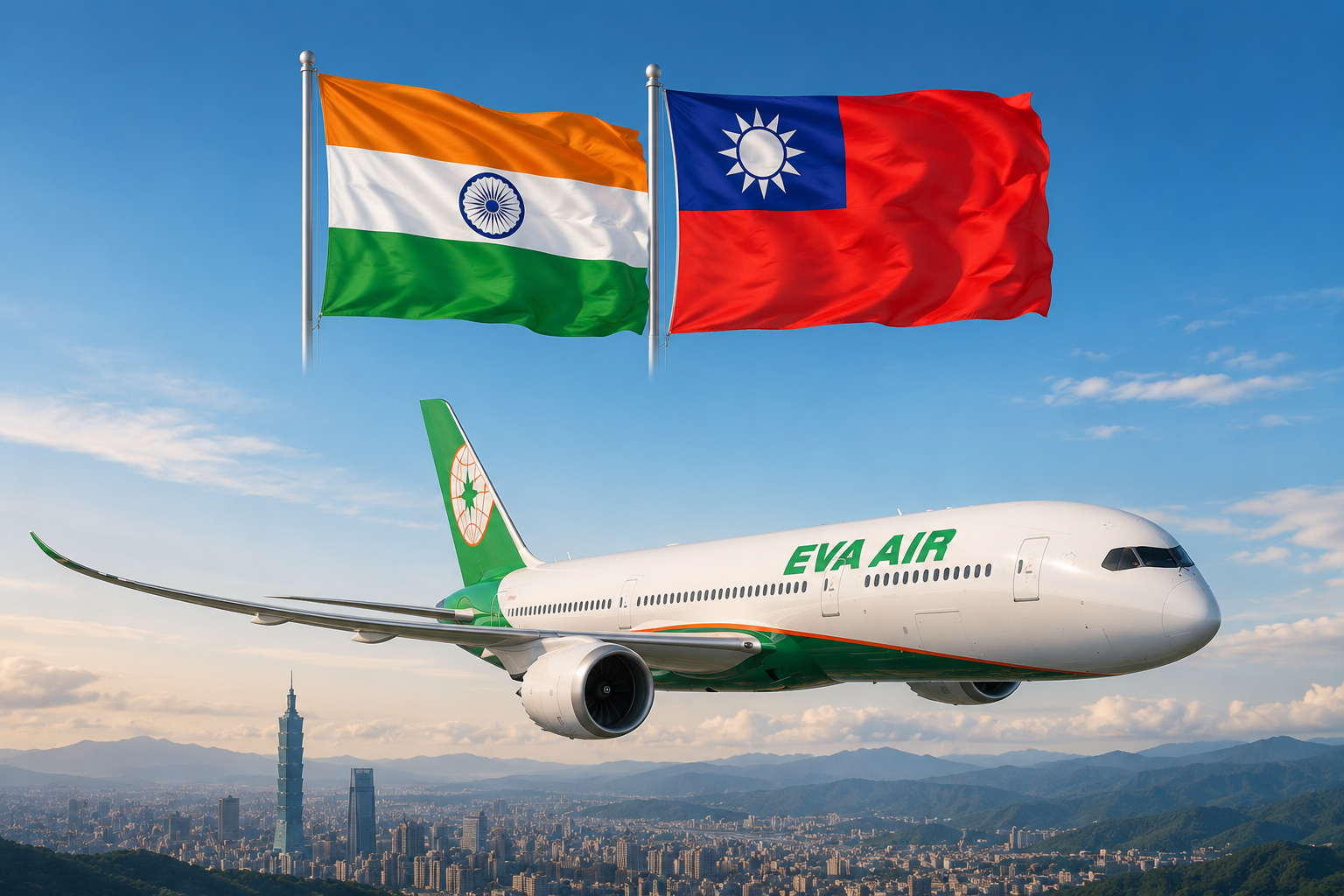
Travel between Taiwan and India is set to become more convenient as EVA Air officially announces a new nonstop service connecting Taipei and Delhi, beginning December 1, 2026.
The new route is an important development for business travelers, students, tourists, and companies operating between Taiwan and India. It will also strengthen Taipei’s role as a connecting hub for travelers from India heading onward to North America and other destinations across Asia.
Five Weekly Flights Between Taipei and Delhi
EVA Air will operate the new Taipei–Delhi route five times a week using Airbus A330-300 aircraft.
The service will operate under the following flight numbers:
Taipei to Delhi: BR367
Delhi to Taipei: BR368
Frequency: Five flights per week
Aircraft: Airbus A330-300
Service begins: December 1, 2026
According to EVA Air’s published schedule, BR367 will depart Taipei at 11:00 and arrive in Delhi at 15:35. The return flight, BR368, will depart Delhi at 19:55 and arrive in Taipei at 04:20 the following day. Flight schedules remain subject to change, so travelers should check the airline’s latest timetable before booking.
A New Direct Link Between Taiwan and India
Until now, travelers flying between Taipei and Delhi generally needed to connect through another Asian or international gateway. The new nonstop service removes the need for a connecting flight and is expected to make travel between the two markets considerably more straightforward.
EVA Air says the new route responds to growing economic connections between Taiwan and India, particularly in areas such as manufacturing, semiconductors, artificial intelligence, and technology.
This could be particularly useful for companies with operations, suppliers, employees, or business partners in both markets.
More Convenient Connections to North America
The route is also strategically important beyond the Taiwan–India market.
EVA Air operates an extensive network from its Taipei hub to destinations across North America. The airline says the new Delhi service will provide Indian travelers with another option for connecting through Taipei when traveling to the United States and Canada.
For eligible Indian nationals traveling to the United States or Canada, EVA Air also highlights Taiwan’s conditional visa-waiver transit arrangements as an additional potential benefit for qualifying travelers. Travelers should verify their individual eligibility and current entry requirements before planning a transit through Taiwan.
Connectivity Beyond Delhi
The new route could also benefit travelers whose final destination is outside India’s capital.
EVA Air has highlighted its partnership with Air India, a fellow Star Alliance member, which can provide onward connectivity from Delhi to other major Indian cities. This creates the possibility of combining EVA Air’s international network with connections within India.
For travelers from Taiwan, Delhi can likewise serve as an entry point to India’s broader domestic network.
Why the Route Matters for Business
The new connection comes at a time when commercial relationships between Taiwan and India are expanding.
Taiwanese companies have increasingly developed interests in India’s manufacturing, electronics, technology, and semiconductor sectors, while Indian companies and professionals are also becoming more engaged with Taiwan’s technology ecosystem.
A direct flight can make a meaningful difference for frequent business travelers. Eliminating a connection can reduce overall journey complexity, make business trips easier to schedule, and provide more predictable travel between the two markets.
For companies working across Taiwan and India, improved air connectivity may also support more frequent face-to-face meetings, technical visits, training programs, conferences, and business development activities.
A Positive Development for Tourism and Education
The route is not only relevant to business travelers.
Taiwanese visitors will have easier access to Delhi and popular destinations such as Agra and Jaipur, while Indian travelers will gain a more convenient direct option for visiting Taiwan.
EVA Air has also announced plans to work with travel partners in Taiwan to offer escorted India tours covering destinations in the famous Golden Triangle, including Delhi, Agra, and Jaipur.
Students, researchers, visiting friends and relatives, and leisure travelers are also expected to benefit from the additional connectivity.
What Travelers Should Know
EVA Air has confirmed that bookings for the new service are already open through its website and travel agencies.
Travelers planning a trip after December 1 should keep in mind that flight schedules and aircraft assignments can change. It is advisable to check the latest information directly with the airline when making travel arrangements.
The launch also marks a significant milestone for EVA Air: the airline says it will become the only Taiwan-based airline offering nonstop passenger flights to India with the introduction of this service.
A Stronger Taiwan–India Travel Corridor
The Taipei–Delhi nonstop service represents more than a new flight route. It is another sign of strengthening connections between two important Asian markets.
With five weekly flights, direct access between Taipei and Delhi, onward connections through Delhi, and EVA Air’s wider network through Taipei, the new service could become an important travel option for business and leisure passengers alike.
From December 1, 2026, traveling between Taiwan and India’s capital will become simpler, faster, and more directly connected — a development that could further encourage tourism, education, investment, and business cooperation between the two markets.
Sources & References
EVA Air – Official Announcement EVA Air To Launch Nonstop Taipei–Delhi Service on December 1 — August 5, 2026. EVA Air Official News Release
EVA Air – Flights to India Official booking and route information for EVA Air’s India services. EVA Air – Flights to India
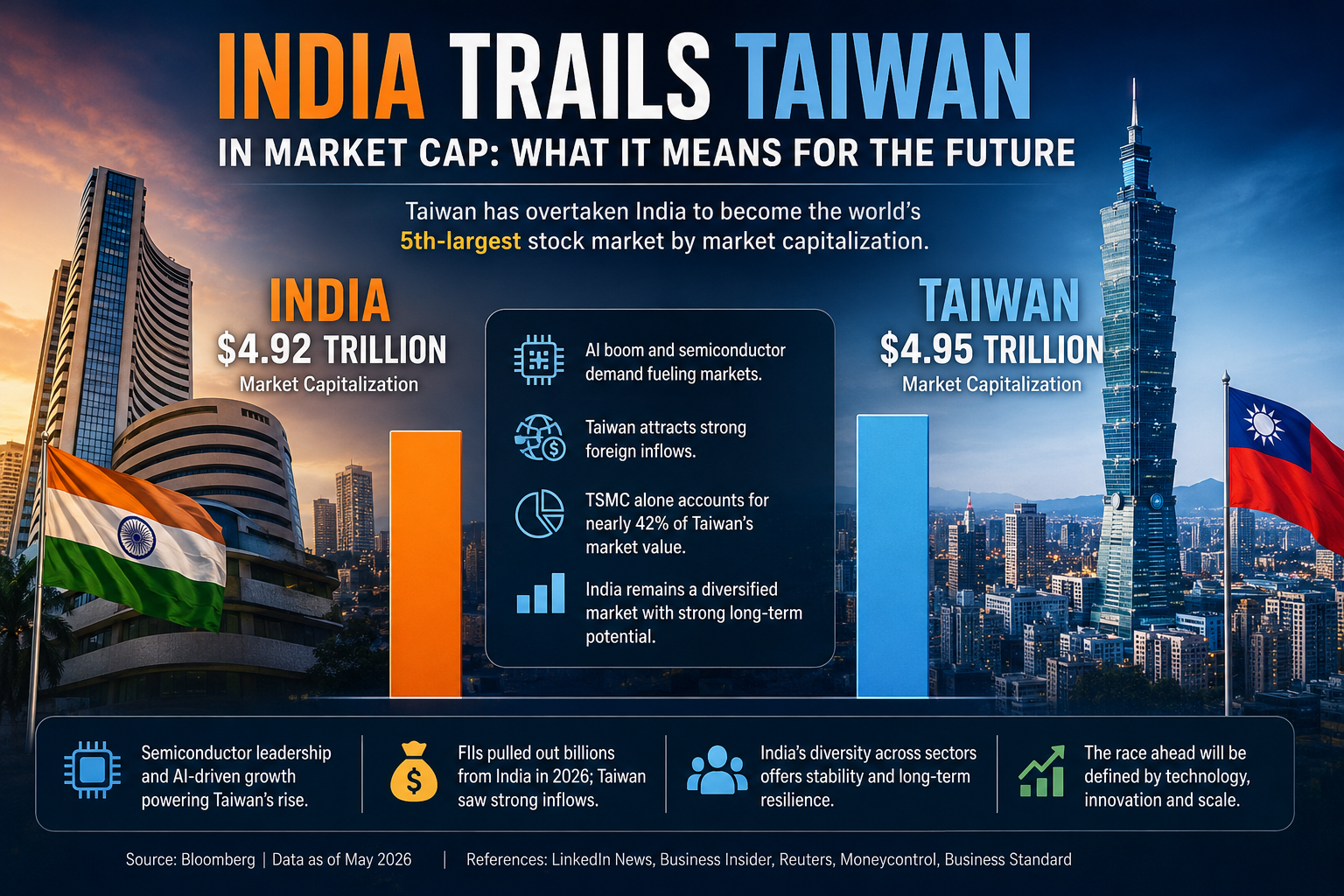
Taiwan has officially overtaken India to become the world’s fifth-largest stock market by market capitalization, a development that has sparked intense discussions among investors, economists, and policymakers. While the gap remains narrow, the shift highlights how artificial intelligence (AI) and semiconductor-driven growth are reshaping global capital markets.
According to Bloomberg data cited across multiple reports, Taiwan’s stock market capitalization reached approximately $4.95 trillion, slightly ahead of India’s $4.92 trillion. The primary reason behind this rise is the extraordinary rally in Taiwan Semiconductor Manufacturing Company (TSMC), the world’s leading chipmaker and one of the biggest beneficiaries of the global AI boom.
The surge in AI investments worldwide has created massive demand for semiconductors, high-performance chips, and advanced computing infrastructure. As companies race to develop AI technologies, investors are pouring money into semiconductor-heavy markets such as Taiwan and South Korea. This has pushed valuations of tech firms sharply higher. Reports also note that companies like SK Hynix and Micron Technology recently entered the trillion-dollar valuation club due to AI-driven optimism.
India, meanwhile, has faced a more challenging environment in recent months. Foreign investors have pulled billions of dollars from Indian equities in 2026, while Taiwan attracted strong overseas inflows. Concerns around slowing earnings growth, limited exposure to AI-related sectors, and global geopolitical uncertainty have affected market sentiment toward India.
However, many experts argue that this ranking change should not be viewed as a sign of weakness in the Indian economy. India’s market structure is fundamentally different from Taiwan’s. Taiwan’s stock market is highly concentrated, with TSMC alone accounting for nearly 42% of the market’s value. India, by contrast, has a far more diversified market spread across banking, manufacturing, energy, pharmaceuticals, technology, infrastructure, and consumer sectors.
SEBI Chairman Tuhin Kanta Pandey recently emphasized this point, stating that India remains “a very diversified market,” unlike Taiwan’s concentrated technology-heavy ecosystem. This diversity may provide India with greater long-term stability even if it limits short-term valuation spikes driven by AI enthusiasm.
The development also raises larger questions about India’s future growth strategy. Global investors are increasingly rewarding countries that dominate high-value technology manufacturing and innovation. Taiwan’s rise demonstrates how critical semiconductor leadership has become in the AI era. For India, this may strengthen the urgency to expand semiconductor manufacturing, AI infrastructure, and advanced technology capabilities under initiatives such as “Make in India” and semiconductor incentive programs.
Ultimately, the India-Taiwan market cap shift is not merely about rankings. It reflects a broader transformation in global investing priorities. Markets linked closely to AI, semiconductors, and advanced technology are attracting unprecedented capital flows. India still retains strong long-term growth potential due to its demographics, consumption economy, and diversified industries, but the latest developments show that future global leadership will increasingly depend on technological depth and innovation-driven growth.
References
LinkedIn News: India Trails Taiwan in Market Cap – https://www.linkedin.com/news/story/india-trails-taiwan-in-market-cap-8868650/
Reuters: Indian shares and market sentiment updates – https://www.reuters.com/world/india/indian-shares-likely-see-muted-start-focus-us-iran-talks-2026-05-27/
Moneycontrol: SEBI Chief comments on diversified Indian market – https://www.moneycontrol.com/news/business/markets/we-are-a-very-very-diversified-market-says-sebi-chief-as-taiwan-overtakes-india-s-m-cap-13931748.html
Business Standard: Taiwan overtakes India as AI rally reshapes global equity market rankings – https://www.business-standard.com/markets/news/taiwan-overtakes-india-as-ai-rally-reshapes-global-equity-market-rankings-126052601443_1.html
Business Insider: AI-driven semiconductor rally and chipmaker valuations – https://www.businessinsider.com/korean-chipmaker-sk-hynix-1-trillion-club-ai-rally-2026-5
New Delhi – President Translation Service Group International(PTSGI), headquartered in Taipei, is a leading provider of professional language translation services (145+ languages) since 1966, continues to expand its presence as a trusted partner for businesses seeking high-quality translation, interpretation, localization, subtitling, dubbing, voice-over, and multilingual content solutions across global markets.
With increasing demand for cross-border communication, regulatory documentation, and multilingual customer engagement, PTSGI supports organizations with accurate, industry-specific language solutions designed to help brands operate seamlessly across diverse languages and cultures.
Meeting the Growing Need for Multilingual Communication
As international business expands rapidly across industries, the need for precise and culturally aligned communication has become essential. PTSGI addresses this demand by delivering professional translation and interpretation services that align with global quality standards, ensuring clients maintain clarity, consistency, and compliance in every market.
From corporate communications to technical manuals, legal contracts, and multimedia content, PTSGI provides tailored solutions that meet both local and international requirements.
Comprehensive Language Services Under One Roof
PTSGI offers a complete portfolio of language services, including:
Professional Translation Services (145+ global languages)
Localization Services (Websites, mobile apps, software, product content)
Subtitling & Captioning (Corporate videos, training modules, media content)
Dubbing & Voice-over Services (Multi-language studio solutions)
Transcription Services
Multilingual Desktop Publishing (DTP)
Each project is executed through a structured workflow that ensures linguistic accuracy, formatting consistency, and timely delivery.
PTSGI India
PTSGI’s India office is coordinated by Mr. Vivek Mishra, who serves as the key point of contact for both domestic and international clients.
Mr. Vivek Mishra oversees end-to-end project coordination, ensuring smooth communication, timely execution, and quality delivery across all service lines. He plays an active role in managing multilingual requirements for corporate, government, and industrial clients, supporting both recurring and high-volume projects with dedicated coordination.
PTSGI differentiates itself through its commitment to quality assurance and professional project management. Every assignment undergoes careful review processes to ensure the highest level of accuracy and consistency.
Key strengths include:
✅ Industry-specialized linguists & subject-matter experts ✅ Multi-step QA and proofreading process ✅ Secure and confidential handling of sensitive documents ✅ Scalable delivery model for bulk and recurring projects ✅ Fast turnaround options for urgent requirements ✅ Dedicated project coordination and responsive support
Supporting Industries Worldwide
PTSGI works with organizations across multiple sectors, including: Legal | Manufacturing | Engineering | HVAC | Energy | Healthcare | IT & Software | Government | Corporate & Marketing
Whether supporting multinational companies, SMEs, or public sector organizations, PTSGI enables clear communication and smoother international operations.
PTSGI is a professional language translation services provider delivering end-to-end multilingual solutions including translation, interpretation, localization, subtitling, dubbing, voice-over, and multilingual publishing. With a strong network of expert linguists and a structured quality assurance process, PTSGI helps organizations communicate effectively across borders and cultures.
Taipei celebrated the arrival of 2026 with its annual New Year’s Eve countdown, climaxing in a dramatic six-minute fireworks show launched from Taipei 101, the iconic skyscraper dominating the city’s skyline.
Theme & Production: The 2026 display, titled “SPARK 101,” featured low-smoke pyrotechnics and was paired with synchronized music composed by young Taiwanese musicians. There were also special light projection segments, including tributes like a “Taiwan’s invisible heroes” theme shown on the tower’s façade before midnight.
Crowd & Celebrations:Tens of thousands of people gathered in Taipei’s Xinyi District and around City Hall Plaza despite rainy conditions to watch the performance and join the countdown festivities, which included concerts and cultural programming leading up to midnight.